

How To Do Data Cleaning Using R
This article was published every bit a role of the Data Science Blogathon
Introduction
Every bit we know that, Data Science is the field of study of study which involves extracting insights from huge amounts of data by the apply of various scientific methods, algorithms, and processes. To excerpt useful knowledge from data, Information Scientists need raw data. This Raw data is a collection of information from various outlines sources and an essential raw material of Data Scientists. It is additionally known every bit principal or source data. Information technology consists of garbage, irregular and inconsistent values which pb to many difficulties. When using data, the insights and analysis extracted are but as good as the data we are using. Essentially, when garbage data is in, then garbage analysis comes out. Here Data cleaning comes into the picture, Data cleansing is an essential part of data science. Data cleaning is the process of removing incorrect, corrupted, garbage, incorrectly formatted, indistinguishable, or incomplete data within a dataset.
What is data cleaning?
When working with multiple data sources, at that place are many chances for information to be wrong, duplicated, or mislabeled. If data is incorrect, outcomes and algorithms are unreliable, even though they may look correct. Information cleaning is the procedure of changing or eliminating garbage, incorrect, duplicate, corrupted, or incomplete data in a dataset. There'southward no such absolute way to describe the precise steps in the data cleaning process because the processes may vary from dataset to dataset. Data cleansing, data cleansing, or data scrub is that the initiative amid the general data preparation process. Data cleaning plays an important role in developing reliable answers and inside the analytical process and is observed to be a bones feature of the info science nuts. The motive of data cleaning services is to construct uniform and standardized data sets that enable data analytical tools and business organization intelligence easy admission and perceive accurate data for each problem.
Why information cleaning is essential?
Data cleaning is the about important task that should exist washed as a data scientific discipline professional. Having incorrect or bad quality data can exist detrimental to processes and assay. Having clean data will ultimately increase overall productivity and permit the very best quality information in your decision-making. Following are some reasons why information cleaning is essential:

Image source: by me
ane. Error-Free Data: When multiple sources of data are combined there may exist chances of so much mistake. Through Data Cleaning, errors tin be removed from data. Having clean information which is free from wrong and garbage values tin can help in performing analysis faster too as efficiently. Past doing this task our considerable corporeality of time is saved. If we use data containing garbage values, the results won't be accurate. When we don't use accurate data, surely we will brand mistakes. Monitoring errors and good reporting helps to discover where errors are coming from, and also makes information technology easier to fix incorrect or corrupt data for future applications.
ii. Data Quality: The quality of the data is the caste to which it follows the rules of particular requirements. For example, if we have imported phone numbers data of different customers, and in some places, we have added email addresses of customers in the information. But because our needs were straightforward for telephone numbers, then the email addresses would exist invalid data. Hither some pieces of data follow a specific format. Some types of numbers have to exist in a specific range. Some information cells might require a selected quite data like numeric, Boolean, etc. In every scenario, there are some mandatory constraints our data should follow. Certain weather touch multiple fields of data in a particular class. Item types of data have unique restrictions. If the data isn't in the required format, information technology would e'er be invalid. Data cleaning will help us simplify this process and avoid useless information values.
3. Authentic and Efficient: Ensuring the information is close to the right values. Nosotros know that near of the data in a dataset are valid, and we should focus on establishing its accuracy. Fifty-fifty if the data is authentic and correct, it doesn't hateful the data is authentic. Determining accuracy helps to effigy out the data entered is authentic or non. For instance, the address of a client is stored in the specified format, maybe it doesn't need to be in the correct ane. The e-mail has an boosted character or value that makes it incorrect or invalid. Some other example is the phone number of a customer. This means that we have to rely on data sources, to cross-bank check the data to figure out if it'due south accurate or not. Depending on the kind of information we are using, we might be able to find various resources that could help usa in this regard for cleaning.
4. Complete Data: Completeness is the caste to which we should know all the required values. Abyss is a little more challenging to accomplish than accuracy or quality. Because it's nearly impossible to accept all the info nosotros demand. Only known facts can be entered. We tin effort to complete data past redoing the data gathering activities similar budgeted the clients again, re-interviewing people, etc. For example, nosotros might need to enter every customer'due south contact information. But a number of them might non accept email addresses. In this case, nosotros have to leave those columns empty. If we have a system that requires usa to fill up all columns, we can attempt to enter missing or unknown there. Simply entering such values does not mean that the data is complete. It would be withal being referred to as incomplete.
v. Maintains Information Consistency: To ensure the data is consistent within the same dataset or across multiple datasets, we can measure consistency by comparing ii similar systems. We tin can also cheque the information values inside the same dataset to see if they are consistent or non. Consistency can be relational. For example, a client's historic period might be 25, which is a valid value and also accurate, merely it is also stated every bit a senior citizen in the aforementioned organisation. In such cases, we have to cantankerous-check the data, similar to measuring accuracy, and see which value is true. Is the client a 25-twelvemonth old? Or the client is a senior citizen? Just one of these values can exist true. There are multiple ways to for your information consequent.
- By checking in dissimilar systems.
- By checking the source.
- By checking the latest data.
Information Cleaning Cycle
It is the method of analyzing, distinguishing, and correcting untidy, raw information. Information cleaning involves filling in missing values, distinguish and set errors present in the dataset. Whereas the techniques used for data cleaning might vary in pace with dissimilar types of datasets, the post-obit are standard steps to map out data cleaning:

Image source: past me
Data cleaning with Pandas
Information scientists spend a huge amount of fourth dimension cleaning datasets and getting them in the grade in which they can piece of work. It is an essential skill of Data Scientists to be able to work with messy data, missing values, inconsistent, noise, or nonsensical information. To piece of work smoothly python provides a congenital-in module Pandas. Pandas is the popular Python library that is mainly used for data processing purposes like cleaning, manipulation, and analysis. Pandas stand for "Python Data Assay Library". Information technology consists of classes to read, process, and write CSV data files. At that place are numerous Data cleaning tools present merely, the Pandas library provides a really fast and efficient way to manage and explore data. Information technology does that by providing united states with Series and DataFrames, which help us not merely to correspond data efficiently but also manipulate information technology in various ways.
In this article, nosotros will use the Pandas module to clean our dataset.
We are using a simple dataset for information cleaning i.east. iris species dataset. You can download this dataset from kaggle.com.
Let'south get started with information cleaning stride past step.
To start working with Pandas nosotros need to import it. We are using Google Colab as IDE, then we will import Pandas in Google Colab.
#importing module import pandas equally pd
Import Dataset
To import the dataset we use the read_csv() function of pandas and store it in the DataFrame named as data. As the dataset is in tabular format, when working with tabular data in Pandas information technology volition be automatically converted in a DataFrame. DataFrame is a two-dimensional, mutable data structure in Python. It is a combination of rows and columns like an excel sheet.
#importing the dataset by reading the csv file information = pd.read_csv(/content/Iris.csv)
#displaying the first five rows of dataset data.head()
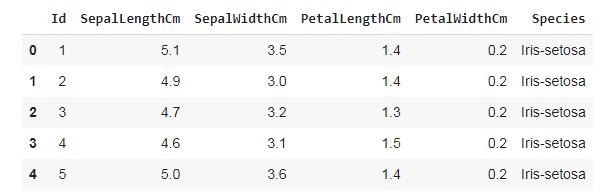
The caput() function is a built-in office in pandas for the dataframe used to display the rows of the dataset. We tin can specify the number of rows by giving the number within the parenthesis. By default, information technology displays the first five rows of the dataset. If we want to see the final five rows of the dataset nosotros use the tail()function of the dataframe like this:
#displayinf last v rows of dataset information.tail()
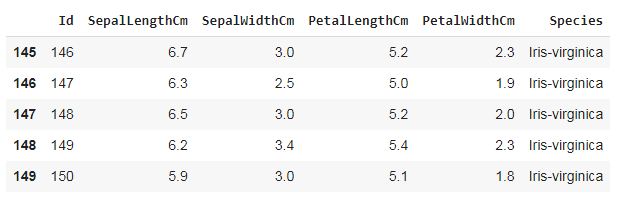
Merge Dataset
Merging the dataset is the process of combining ii datasets in one, and line up rows based on some particular or common property for data assay. We tin can do this by using the merge() part of the dataframe. Following is the syntax of the merge function:
DataFrame_name.merge(right,how='inner', on=None, left_on=None, right_on=None, left_index=Imitation, right_index=False, sort=Fake, suffixes=('_x', '_y'), copy=True,indicator=False, validate=None) [source]
But in this case, nosotros don't need to merge two datasets. So, nosotros will skip this stride.
Rebuild Missing Information
To find and fill up the missing data in the dataset we will use another function. At that place are iv ways to find the nix values if present in the dataset. Allow'due south encounter them ane past ane:
Using isnull() function:
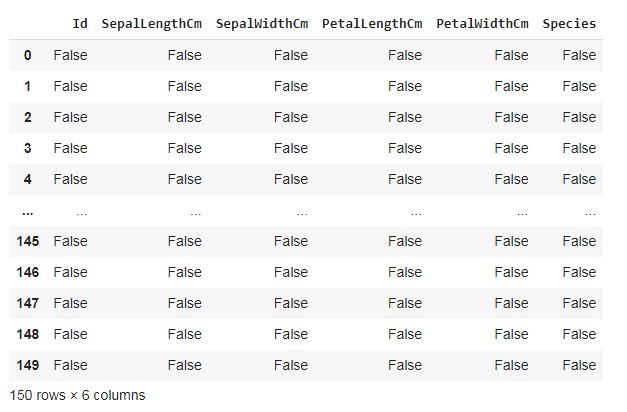
This part provides the boolean value for the complete dataset to know if any nothing value is present or not.
Using isna() office:
information.isna()
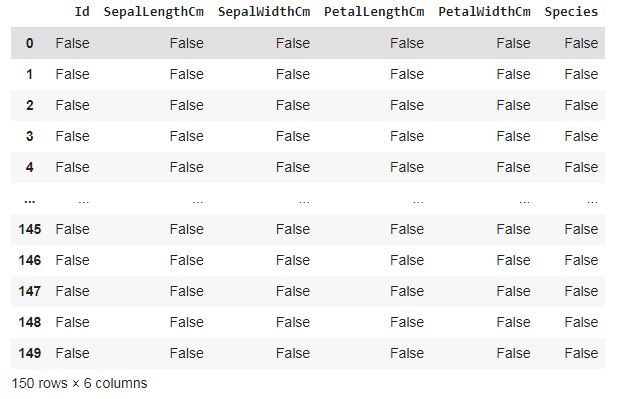
This is the aforementioned as the isnull() function. Ans provides the same output.
Using isna().any()
information.isna().any()
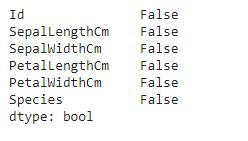
This function also gives a boolean value if any null value is nowadays or non, but it gives results column-wise, non in tabular format.
Using isna(). sum()
data.isna().sum()
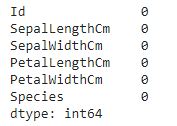
This function gives the sum of the nada values preset in the dataset column-wise.
Using isna().whatsoever().sum()
information.isna().any().sum()
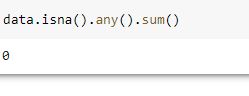
This function gives output in a single value if whatever cipher is present or not.
There are no cypher values present in our dataset. Merely if at that place are any nil value south preset we can fill those places with whatever other value using the fillna() role of DataFrame.Following is the syntax of fillna() function:
DataFrame_name.fillna ( value=None , method=None , centrality=None , inplace=False , limit=None , downcast=None)
[source]
This role will fill NA/NaN or 0 values in place of nada spaces.
Standardization and Normalization
Information Standardization and Normalization is a common practice in machine learning.
Standardization is some other scaling technique where the values are centered around the mean with a unit of measurement standard deviation. This means that the mean of the attribute becomes zero and the resultant distribution has a unit standard difference.
Normalization is a scaling technique in which values are shifted and rescaled then that they stop up ranging between 0 and 1. It is also known equally Min-Max scaling.
To know more about this click hither.
This step is not needed for the dataset we are using. Then, we will skip this stride.
De-Indistinguishable
De-Indistinguishable ways remove all duplicate values. There is no need for duplicate values in data analysis. These values only touch on the accuracy and efficiency of the analysis issue. To notice indistinguishable values in the dataset we volition utilise a simple dataframe function i.e. duplicated(). Allow's see the example:
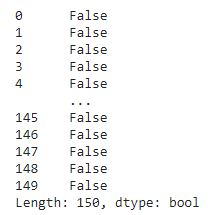
This office also provides bool values for duplicate values in the dataset. As we can see that dataset doesn't contain any duplicate values.
If a dataset contains duplicate values it can be removed using the drop_duplicates() function. Post-obit is the syntax of this role:
DataFrame_name.drop_duplicates(subset=None, keep='kickoff', inplace=False, ignore_index=Simulated)
[source]
Verify and Enrich
Subsequently removing null, indistinguishable, and incorrect values, we should verify the dataset and validate its accuracy. In this footstep, we have to check that the information cleaned so far is making any sense. If the data is incomplete we take to enrich the data again by data gathering activities like budgeted the clients once more, re-interviewing people, etc. Completeness is a little more than challenging to achieve accuracy or quality in the dataset.
Consign Dataset
This is the last pace of the data cleaning process. After performing all the above operations, the data is transformed into clean the dataset and information technology is ready to export for the next process in Data Science or Information Analysis.
This brings us to the end of this commodity. I hope you enjoyed the commodity and increased your cognition most Data Cleaning Process.
Thanks for Reading. Practice let me know your comments and feedback in the comment section.
For more than articles click here.
The media shown in this article are non endemic by Analytics Vidhya and are used at the Author'southward discretion.

Source: https://www.analyticsvidhya.com/blog/2021/06/data-cleaning-using-pandas/
Posted by: jacksonchrocied.blogspot.com
0 Response to "How To Do Data Cleaning Using R"
Post a Comment